

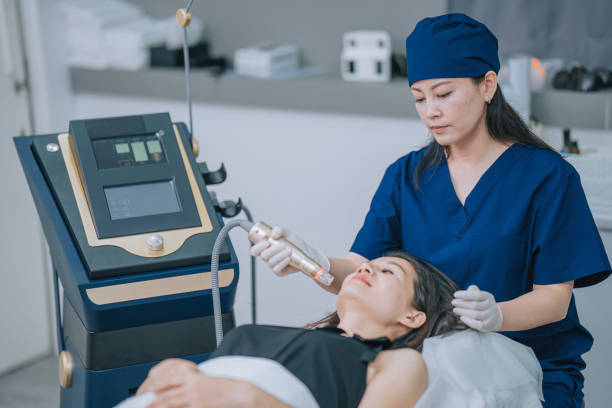
Quick Answer: Laser skin tightening works by heating the deeper layers of the skin, the dermis, enough to damage old collagen fibers and trigger the body to build new ones. Over the following three to six months, that fresh collagen pulls skin firmer from the inside out. Most patients need three to five sessions to see a real difference.
Here’s something most people don’t realize until their late thirties: skin doesn’t loosen because it stretches. It loosens because collagen production slows down, by roughly one percent a year after age twenty, according to dermatology research published in the Journal of Investigative Dermatology. By the time jawlines start to soften or eyelids begin to hood, the real issue is a collagen deficit, not extra skin.
That’s the gap laser skin tightening was built to close.
What Happens Inside the Skin During a Treatment
A laser handpiece delivers controlled heat energy to the dermis, the layer sitting beneath the surface skin cells. Devices like Fraxel and CO2 fractional lasers reach temperatures between 60 and 70 degrees Celsius in targeted zones. That heat does two things at once. It denatures existing collagen, which sounds destructive but actually signals the body to start a repair response, and it stimulates fibroblasts, the cells responsible for producing new collagen and elastin.
The skin’s surface usually stays intact or only lightly resurfaces, depending on whether the provider uses an ablative or non-ablative laser. Ablative lasers (think traditional CO2 or Erbium devices) remove a thin layer of surface skin along with heating the dermis. Non-ablative lasers, like Clear + Brilliant, skip the surface entirely and work only on the deeper layer. Recovery time differs sharply between the two, and a qualified provider will pick based on your skin type, downtime tolerance, and the specific area being treated.
I’ve talked to patients who assumed the tightening happens immediately, right there on the treatment table. It doesn’t. The visible lift builds gradually as new collagen forms, which is why this isn’t a same-day fix the way Botox can be.
Why Results Take Months, Not Days
Collagen remodeling is a biological process, not a mechanical one. After a session, the body needs time to clear out the damaged collagen fibers and lay down new ones in an organized pattern. That process typically runs 90 to 180 days per cycle, and most providers schedule sessions four to six weeks apart so the skin can keep building between visits.
A 2019 review in Lasers in Surgery and Medicine looked at over 700 patients across multiple laser tightening studies and found that visible improvement in skin laxity continued increasing for up to six months after the final session, even with no further treatment. That delayed payoff trips people up. They expect a facelift’s instant result and instead get something closer to fitness progress: gradual, compounding, and dependent on consistency.
Where on the Body It Works Best
Laser skin tightening tends to perform best on areas with moderate, early-stage laxity, not significant sagging. That includes the lower face and jawline, the neck (a notoriously stubborn area for topical products), under-eye skin, and the décolletage. For patients dealing with more advanced skin laxity, particularly around the jowls or neck after major weight loss, results are usually modest, and a provider may recommend combining laser skin tightening with radiofrequency microneedling or a surgical consult for realistic expectations.
Skin type matters too. Fitzpatrick skin types IV through VI carry a higher risk of post-inflammatory hyperpigmentation with ablative lasers specifically, so an experienced provider will often default to non-ablative or radiofrequency-based options for darker skin tones rather than risk discoloration.
Laser Tightening Versus Radiofrequency Tightening
People often lump these together, but they’re not interchangeable. Laser tightening uses light energy absorbed by water in the skin to generate heat. Radiofrequency devices, like Thermage or Morpheus8, use electrical current passed through tissue to generate heat instead. RF tends to penetrate deeper and more evenly, which makes it a common choice for body areas like the abdomen or upper arms. Lasers, on the other hand, offer more precision for facial work and can simultaneously address pigmentation or texture issues that RF alone won’t touch.
Neither is objectively better. The right choice depends on the treatment area, skin type, and whether texture or tone correction is also a goal. A provider who only offers one modality has an obvious incentive to recommend it regardless of fit, so it’s worth asking what alternatives were considered for your specific case.
What a Session Actually Feels Like
Most patients describe the sensation as warm snapping, similar to a rubber band flicked against skin, with cooling air or a chilled tip used between passes to manage discomfort. Topical numbing cream is standard for ablative treatments. Sessions run anywhere from 20 minutes for a focused area like the under-eyes to 60 minutes for a full face and neck.
Redness and mild swelling are common for 24 to 72 hours afterward. Ablative treatments carry longer downtime, sometimes five to seven days of visible peeling, while non-ablative sessions usually let patients return to normal activity within a day.
How Many Sessions Does It Actually Take
A single session produces measurable but modest change. Most treatment plans call for three to five sessions spaced four to six weeks apart, with maintenance touch-ups every six to twelve months after the initial series. Skipping maintenance doesn’t reverse progress overnight, but the natural aging process continues, so results aren’t permanent in the way a surgical lift can be.
The Honest Bottom Line
Laser skin tightening isn’t a miracle device, and any provider who promises facelift-level results from one session is overselling it. What it does well is slow the visible signs of collagen loss using your own body’s repair mechanisms, with real downtime tradeoffs depending on which laser type you choose. If you’re dealing with early laxity and want to avoid surgery, it’s worth a consultation. If you’re already seeing significant sagging, ask your provider for an honest assessment of whether lasers alone will get you there.
Frequently Asked Questions
Q: Is laser skin tightening painful?
A: Most patients rate it as mildly uncomfortable rather than painful, especially with topical numbing cream. Ablative treatments tend to feel more intense than non-ablative ones.
Q: How long do results from laser skin tightening last?
A: Results typically last 12 to 18 months before natural collagen decline catches up, which is why annual maintenance sessions are common.
Q: What’s the difference between laser skin tightening and a non surgical facelift?
A: Laser tightening targets collagen at a cellular level using heat, while non surgical facelift is a broader category that can include lasers, radiofrequency, ultrasound, and injectables combined.
Q: Can laser skin tightening replace a surgical facelift?
A: For mild to moderate laxity, yes, it can delay or replace the need for surgery. For significant sagging or excess skin, laser treatments alone usually fall short.
Q: How soon will I see results after laser skin tightening?
A: Subtle improvement may appear within a few weeks, but full collagen remodeling and visible tightening take three to six months.